
The internet was always text-led, but “writing” isn’t just text, right? The ubiquity of text tends to blind us to the fact that writing is ultimately an art form. And like all art, the purpose of writing, too, is to A) guide the discovery of truth, and to B) birth new ideas. As much as ideas have been diminished now to being inferior to execution, they still do run the world. It’s just that good ones are becoming rarer to come by.
Writing is what a lot of people choose to do when they are obsessive thinkers who have found their medium of expression in words and language — much like an artist finds theirs in paints and canvas, or a musician does in an instrument. Writing is made when the writer has an original thought or two, and a few inspired ones, that they can visualise being somehow weaved into a story they get to finally call their own, original creation. This creation could be an article, an essay, a poem, a research-paper even… whatever the name, there is always something ultimately “inventive” to writing… to good writing anyway.
Now, this kind of writing — good writing, inventive writing, original writing, writers’ writing… whatever you want to call it so as to distinguish it from the pervasiveness of the generally ubiquitous written word — really took form on the internet in the era of blogging. Late 1990s? Probably later for this side of the world. Anyway, this is not a history piece.
Blogging
I took to blogging in 2009.
One fine day, I came back home utterly dissatisfied with all the time I had wasted seeking craft-related connection in college clubs. I had hoped that clubs would be made up of people wanting to perfect a craft together. Instead, they turned out to be curated settings for socialisation. The music club, for example, was mostly musicians who wanted to just hang out with other musicians — they weren’t interested in actually learning or making music together (except on special occasions). Despite so many good musicians spending time everyday in shared spaces, no band was birthed. What is even the point, I thought.
I sat down in front of the bulky second-hand monitor that was housed in the tiny store-room of our house, and started a ✨blog✨. Thus began my long-standing tryst with the most unrecognised form of writing — internet-writing.
In writing on the internet I found my refuge, my escape, my community. Yes, “community building” is not new, writing on the internet was always about building a community around you that you couldn’t find in real life. Like many of us, I created many web spaces and corners over the years through writing. A satire platform I co-founded (News That Matters Not, ’09-’13) went on to become a high-traffic website (second to Faking News), won a couple of international awards, and was covered in most mainstream print-media in India (had we not been two college kids who were in it only for the love of writing, we might have known to make something of it). My personal blog (it still lives, hidden in a corner you’ll hopefully never get access to) did the rounds in a few of those silly but sweet blogger awards.
Gradually, I moved over to writing platforms, much like everyone else.
Twitter, Quora, LinkedIn
Twitter came right at the brink of long-form writing (i.e blogging) getting saturated. The onslaught of social media addiction had been impairing people’s control over their own attention spans. Twitter’s awfully simple character-limitation birthed the “Tweet” — you could (or had to) now both express and grasp gigantic ideas in 140 characters. It felt like the barrier to being a “writer” (and subsequently, being a “reader”), or feeling like one, had suddenly been lowered. It had always been possible to write in 140 characters, or 250, or 5500… but it was 140 characters that became a thing, because a very cool and fun platform called Twitter legitimised these 140 characters as “writing”. This, my friends, is how platforms birth new formats. And what Twitter had done with the Tweet was nothing short of splendid, both in its simplicity and its timing.
Gradually, in tweets and posts and captions and shorthand messages, short-form writing became all the rage. Until, millennials started getting (rightfully) mocked and ridiculed for talking lyk dis.
I adopted Quora when it had just started getting talked about. They had managed to turn the good old “Q&A” into a writing format — and they did it via community. Their early platform was closed and invite-only, allowing you to read into the beautiful brains of highly credible scientists, academics, authors, mathematicians, and fairly niche subject matter experts who were also naturally brilliant writers with well-formed voices. The whole thing felt brainy, and made you want to participate in the same Q&A as everyone else. To get a like, comment, or DM (!) from one of the geniuses that Quora had recruited in its earliest phase felt like an honour. Of course, as all growth strategies go, Quora gradually opened up the platform to more writers, while still remaining relatively selective as far as algorithmic visibility was concerned. Some years later, in 2015, I became one of their “Top Writers”. Soon after, the platform exploded (thanks to its changing algorithms and exponential rise of adoption in India) and I made a silent exit. When I think about that period of writing, I realise that to the (aspiring) writer in me, Quora’s Q&A format had been the ultimate squasher of the writers’ block. Perhaps to a fault, considering the very global vomit-storm of words it continues to invite.
Later, LinkedIn with its focus on all things “career” and “technology”, and its pivot to a feed-first homepage design, felt inviting to those like me who were wondering what to write about. If you were an engineer, you wrote about engineering; if you were a manager, you wrote about management. There were many engineers and managers in the world, and, to nobody’s surprise, they had finally found something to write about that others were reading. Suddenly, they too were interesting to others, not despite their boring job, but because of it (!). The global cringe-storm that LinkedIn is parodied for today wasn’t a product of a new writing format to begin with (LinkedIn’s “Post” was a direct lift-off from Facebook), but of a collective that homogenised their writing in their shared quest to appear to each other more interesting than they really were. Techbros and white-collar workers all over the world converged to birth the cringe, the disease, the cesspool that LinkedIn is today.



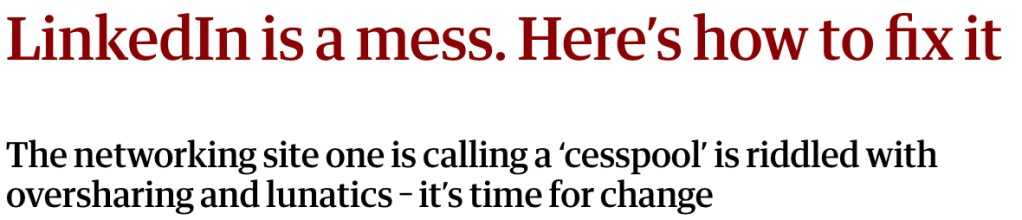
When I started writing on LinkedIn, it had just about started on the hockey-stick engagement curve. I continue to write there, in rebellion against the perception of cringe that the “LinkedIn Top Voice” label accords me. But mainly because it is still the best source of unsolicited opportunities for the average layman.
*
I couldn’t even process WHEN the switch from blogging to platforms happened. It felt natural but I am sure, the people behind Twitter, Quora, LinkedIn etc. had seen something coming. Perhaps, too many blogs had been created, perhaps people’s attention spans were drifting, or perhaps it was just that in the information age, “more” was the flavour. The more people you read from (i.e, “followed”), the more knowledgeable you felt. In a sense, this was also the age of self-styled polymaths — some real ones, but most of us masquerading as polymaths while being directionally clueless and perennially self-unaware. As anyone who has been partaking in internet-writing for as long as I have might attest — the platforms quenched our thirst to be seen, and in doing so, inadvertently shaped us. Through all these years of writing on internet platforms (15 and counting), I cannot deny picking up a little bit from here-and-there to become the high on general intelligence, low on specific-intelligence person I am today.
Dialling Back to Long Form: Medium and Substack
When it comes to content, formats usually are notoriously fleeting. Twitter’s genius was in making a new format out of a literal limitation, which they could always reverse, update, even remove altogether to remain or grow in business. Unsurprisingly, this is what Twitter ultimately did, under Musk.
Medium in around 2014, and Substack in more recent years, in a way resurrected long form writing. The format had never gone away, but the explosion of video and short formats certainly had been pushing it to the background. The difference was that by now, professional writers had been joined by professional trolls, provocateurs, and rage-baiters across platforms. This raised the stakes — real writers now expected to make money from internet-writing. And that is exactly what Medium and Substack led with.
Both Medium and Substack remodelled blogging into the newsletter format (or remodelled newsletters into blogging?), combined it with the platform-ness of Twitter, of LinkedIn, of every other social platform that had existed before, and packaged it all as a neat space for writers to hone their craft, build their communities, own their independent voice and identity, all while (supposedly) making money. Enter, subscriptions.
The Subscription Economy (Problem)
Subscription-based newsletters as a format and as a business model arrived at a time that was, unsurprisingly, close to the overdoing of the “subscription economy”.
New formats of writing (and perhaps, content at large) will always come and go. Boomers had a format of writing on the internet (think HTML sites and Bulletin Boards), millennials have had these umpteen platforms, GenZ will probably move on from Instagram to something else in the future (unless current platforms dramatically pivot to centre around their unique vocabulary and interests). Formats emerge from generational evolutions in language, media, culture, news, social-order, and more. Naturally, then, there is nothing permanent about them.
Some entrepreneurs may still choose to build new formats — I have considered it myself — but it is in the “monetisation” that writing and writers need saving. And no, subscription isn’t it.
You see, to do writing — good writing, inventive writing, writers’ writing, or whatever else you chose to call it earlier — takes time, as it should. It takes courage and vulnerability, as it should. It causes great mental and emotional fatigue to the writer, as it should. And where a massive revelation of truth or extremely sensitive material is concerned, it can even bring great personal risk for the writer, as it (unfortunately) should. AI doesn’t change that. Platforms don’t change that.
To be a writer is different from running a subscription. The moment you launch a subscription, you owe your subscriber a rigidly consistent quality of writing at a pre-decided and pre-informed frequency. A subscription is a transaction, after all, an agreement. And as any (good) writer will tell you, this just isn’t scalable. Truly good writers write frequently, publish rarely… or at least infrequently.
Imagine expecting Salman Rushdie to send a story in your inbox every Sunday, or Malcolm Gladwell nervously typing away half-researched, half-baked, trite, or even plagiarised prose to meet his weekly 9 PM deadline for his five thousand subscribers on Substack.
Subscriptions may be a good business model for platforms, or groups of people, but they aren’t a good model for writers. A piece of original, valuable writing in 2025 and beyond needs to be monetisable on its own merit. Readers who want to read it should pay for it, writers who want to write it should be able to charge for it. The next NYTs, Wireds, Atlantics, Rolling Stones, HBRs, Forbes, WSJs, Salons etc. could very well be one-person publications instead of large media conglomerates. For that to happen, good writers on the internet should be able to earn for each piece of writing the same way they would have been paid, had their submission been accepted by a named media publication. Well, at least something of that sort.
The Case For Pay-Per-Think
In a sea of text, good writing will always stand out on its own. This is why, despite all the innovation in formats and media technologies, writing continues to not just live, but thrive. People who shaped the early internet are turning into writers and bloggers, because all that lies in the end of everything is art. And for those who see words as paints and a blank document (or paper) as their canvas, writing is all the art they will ever know.
What is needed seems simple to me. The internet’s business-model around writing needs to evolve, to meet the maturity of its writers. Words have never been cheaper, and yet, they have never been more valuable. The internet is about to get humongous with text, but for it to become equally significant in its value to the people it serves, writing needs to make money. Good writing needs to make a lot of money.
A good quality piece of writing is a sizeable amount of work. Sometimes, a single article can be a writer’s entire life’s work. Next time you find a fabulous essay that blows your mind, gives words to something you had been trying to express, sparks new ideas for you, or just impresses your socks off, think about what would have gone into making all the ideas come together in such perfect choreography. Then think about how much you would have paid for the experience of witnessing this choreography. And then think about the choreographer. Doesn’t he/she deserve a bit more than being the unpaid employee of writing platforms?
***


What did you think?